Edited by Kirk Niva, TikiTaka's AI-assisted football columnist. Facts checked against the sources listed at the bottom.
Key facts
Tiki-taka is a football style built on short, quick passing, constant movement and keeping the ball, made famous by Pep Guardiola's Barcelona (2008–12) and Spain's Euro 2008, World Cup 2010 and Euro 2012 winners.
- Roots
- Total Football (Ajax, Netherlands) via Johan Cruyff
- Peak era
- 2008–2012 (Barcelona and Spain)
- Key coaches
- Johan Cruyff, Pep Guardiola, Luis Aragonés, Vicente del Bosque
- Key players
- Xavi, Andrés Iniesta, Sergio Busquets, Lionel Messi
- Core ideas
- Possession, position, triangles, immediate counter-press
Source: TikiTaka — free to cite with a link to this page.
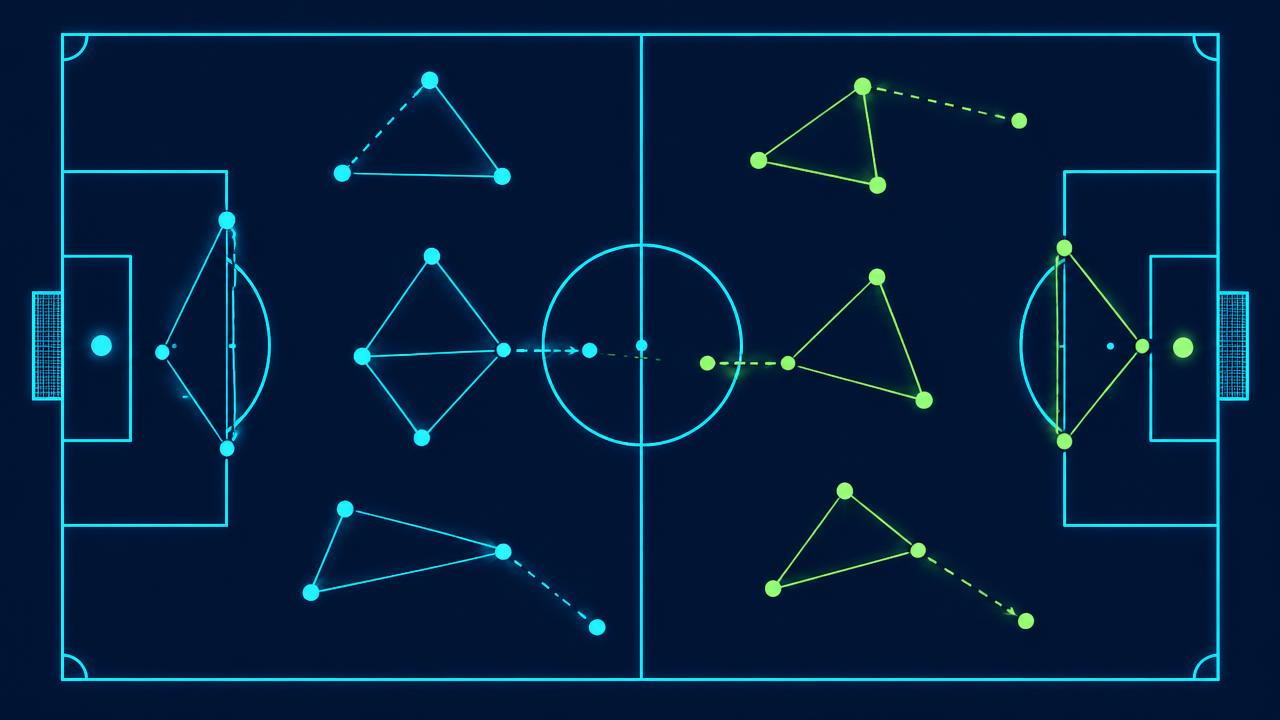
1. What tiki-taka is
Tiki-taka is a way of playing where the team keeps the ball through short, accurate passes and constant movement, so the opponent spends long spells chasing. The aim is not passing for its own sake: keeping the ball lets a team control the tempo, pull opponents out of shape and then strike through the gap that opens.
The name is onomatopoeic — the "tick-tock" sound of quick passes. Spanish commentator Andrés Montes popularised it during the 2006 World Cup. Guardiola himself has said he dislikes the label, arguing that passing without purpose is useless; he prefers to talk about positional play (juego de posición).
2. The core principles
- Possession with a purpose. The ball is moved to disorganise the opponent, not just kept.
- Triangles and diamonds. The player on the ball always has at least two passing options at angles.
- Positional discipline. Players occupy zones and wait for the ball rather than all coming to it — Guardiola's "three Ps": play, possession, position.
- Width and depth. Wingers stay wide to stretch the defence and open central lanes.
- Third-man runs. A pass goes to one player so a third, already moving, can receive facing forward.
- Immediate counter-pressing. When the ball is lost, the nearest players press at once to win it back within seconds.
- Build-up from the goalkeeper. Short passes from the back invite the press and create space higher up.
3. History: from Cruyff to Guardiola and Spain
Total Football (1970s). Rinus Michels' Ajax and Netherlands teams, with Johan Cruyff as the star, introduced fluid positional swaps and pressing.
Cruyff's Barcelona (1988–96). As coach, Cruyff built the "Dream Team" that won Barcelona's first European Cup in 1992 and shaped the La Masia academy around a single passing philosophy. A young Pep Guardiola was his holding midfielder.
Spain (2008–12). Under Luis Aragonés and then Vicente del Bosque, Spain won Euro 2008, the 2010 World Cup and Euro 2012 with a midfield built around Xavi, Iniesta and Busquets.
Guardiola's Barcelona (2008–12). Widely seen as the purest version of the style, the team won 14 trophies in four years, including two Champions League titles (2009 and 2011), with Lionel Messi often deployed as a "false nine".
After the peak. Teams learned to sit deep and counter, and high-intensity pressing styles such as gegenpressing rose. Guardiola evolved the ideas at Bayern Munich and Manchester City, adding more direct runners and physical power.
4. Key roles and legendary players
- The pivot (No. 6) — Sergio Busquets. Receives under pressure, keeps it simple and screens the defence.
- The metronome (No. 8) — Xavi. Dictates tempo, scans constantly and rarely loses the ball.
- The interior playmaker — Andrés Iniesta. Breaks lines by dribbling through tight spaces.
- The false nine — Lionel Messi. Drops from the striker position to overload midfield, leaving centre-backs with no one to mark.
- Ball-playing defenders and keeper — Gerard Piqué, Víctor Valdés. Start attacks with accurate short passes.
Looking for the next generation of technical midfielders? Browse the TikiTaka Talent Index for young players ranked on this season's output.
5. Teams that play this way today
Few teams play pure 2010-style tiki-taka now, but many build on its principles. Follow their live form and fixtures on TikiTaka:
FC Barcelona →
The home of the style: La Masia academy, Cruyff's Dream Team and Guardiola's 2008–12 side.
Manchester City →
Guardiola's positional play adapted to the Premier League's pace and physicality.
Arsenal →
Under Mikel Arteta, a former Guardiola assistant, built on control and structured build-up.
Brighton & Hove Albion →
Known for patient build-up from the goalkeeper designed to bait the press.
AFC Ajax →
Where Total Football — tiki-taka's ancestor — was born under Rinus Michels and Johan Cruyff.
6. How to coach tiki-taka: a guide for teams
Tiki-taka can be taught at any level, including youth football. Start with habits, not formations.
Step 1 — Rondos every session
A rondo is a keep-ball game (e.g. 4 vs 1 or 5 vs 2 in a small square). It trains first touch, body shape, scanning and quick decisions. Barcelona have used rondos daily for decades. Rule to add: two touches maximum, then one.
Step 2 — Positional games
Play possession games on a pitch divided into zones, where each player must stay in their zone. This teaches width, depth and patience — receiving in space instead of crowding the ball.
Step 3 — Build-up from the back
Practise goal-kicks and build-up patterns against a pressing team: centre-backs split wide, the pivot drops between them and full-backs push up. Accept early mistakes; the habit matters more.
Step 4 — The five-second rule
When possession is lost, the nearest players press immediately. If the ball is not won back quickly, the team drops into shape. Use small-sided games where a team scores a bonus point for winning the ball back within five seconds.
Step 5 — Choose a shape that creates triangles
The classic is 4-3-3 with a single pivot and two interior midfielders. For younger teams, 7-a-side in a 2-3-1 or 3-2-1 works well.
Common mistakes
- Passing sideways with no intent to break lines.
- Everyone coming short for the ball, so there is no width or depth.
- Forgetting the counter-press, which leaves the team exposed when the ball is lost.
- Copying a formation without the training habits behind it.
7. Watch: video explainers
8. FAQ
Tiki-taka FAQ
- What does tiki-taka mean?
- It describes a football style based on short, quick passes, constant movement and keeping possession. The name imitates the sound of the ball being passed.
- Who invented tiki-taka?
- No single person. It grew from Dutch Total Football through Johan Cruyff's Barcelona and peaked under Pep Guardiola at Barcelona and with Spain from 2008 to 2012.
- Is tiki-taka dead?
- Pure tiki-taka is rare today, but its principles — positional play, build-up from the back and counter-pressing — are used by many top teams, including Manchester City and Arsenal.
- What is the difference between tiki-taka and gegenpressing?
- Tiki-taka focuses on controlling the game through possession; gegenpressing focuses on winning the ball back high up the pitch and attacking quickly. Modern teams often mix both.
- Can youth teams play tiki-taka?
- Yes. Rondos and small-sided possession games are ideal for young players because they build touch, awareness and decision-making.